De Zonnepolder
Nieuwe burenDe Zonnepolder is the new-build district where Peter and Eva move into Melkweg 1 after the death of their daughter, Lieve. Planned as a comfortable, child-friendly home for a family they expected to raise there, it instead becomes a charged landscape: first a place shaped by unrealized domestic hopes, and later, in Peter’s crisis, an apparently suffocating environment from which he wants to escape.
A promised landscape
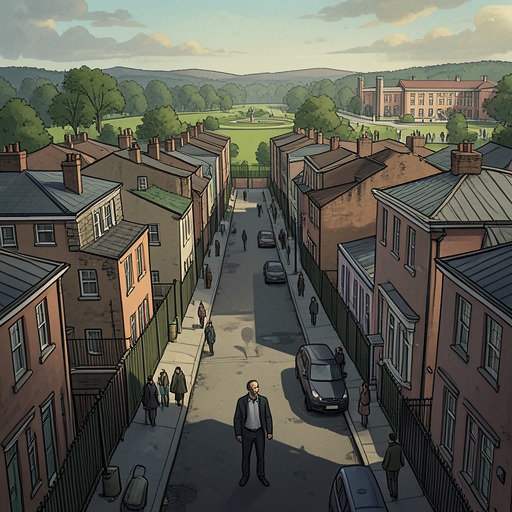
The district is introduced through the gap between its sales language and its unfinished appearance. A brochure for part of De Zonnepolder promised houses designed by Bakker & Van Haasdrecht, with Russian, Etruscan, Italian, and Egyptian façades that would make residents feel permanently on holiday. When the homes on Mercuriusplein are completed, Peter cannot find the Italian or Egyptian details. To him, the houses look like concrete blocks dropped into a sandy wasteland. The street named Melkweg has no paving stones yet; rain and the heavy traffic of people moving in have sunk the steel road plates into the mud, repeatedly trapping the moving van.
That first impression gives the district a defining contrast. Its names and marketing conjure a designed, inviting world, while its actual streets are still raw and difficult to use. The homes are new, but the surroundings have not yet acquired the finished civic spaces or ease of movement promised by the plan. The neighborhood’s ordinary beginnings are visible in the mud, construction delays, and labor of moving rather than in the polished image of a model development.
Melkweg 1 and the family that was planned
Peter and Eva have chosen a semi-detached house at Melkweg 1 because they expect it to suit a child’s life. The vacant ground beside it is meant to become Mercuriusplein, with a football field, half-pipe, climbing tower, and sandbox. Their imagined daily routine is equally practical: a nursery around the corner, a school and supermarket within walking distance, and a child able to cycle through a quiet neighborhood and play with friends in the square. The development’s mix of terraced houses, semi-detached villas, and detached houses appears to offer a comfortable setting among different kinds of residents.
The home records those expectations in its fittings. Eva has not visited for more than six months, and Peter recognizes that neither their family nor their friends and colleagues have shared in the building process. He has laid broad strips of antique-oak-look laminate and finished them in whitewash, as Eva once wanted. The kitchen is the beach-white one they selected together while Lieve was still unborn. They planned for a microwave to warm bottles and rejected a boiling-water tap because a toddler might burn her hands. The room beneath the large tilt window had been intended for a child; Peter has made it into a spacious, light-filled computer room instead. He has worked evenings and weekends, painting and laying the Portuguese stone tiles, in an effort to create Eva’s dream house and give her something after their loss.
Moving in after loss
Three days after the birth, following Lieve’s death, Peter asks the estate agent to put Melkweg 1 back on the market. The couple had won the house in a lottery when applications exceeded the number available, and had taken that outcome as a favorable sign that this time things would work. The agent cannot sell it. He explains that conditions have changed: people are staying put, feel afraid, and prefer to rent until the economy improves. With no sale possible, Peter and Eva have to leave their city rental flat and move into the house they had hoped not to occupy in these circumstances.
The move therefore brings the district’s promise and its painful reversal into the same scene. On the plot where their front garden will be, Peter and Eva park the van with its rear doors facing the entrance and lay wooden boards over the mud. Around them, other households are also carrying boxes and furniture in rain boots. Their house is not merely an unsuccessful property transaction: it is the material form of a future prepared for Lieve, now entered after her death. The child’s room has changed use, while the nearby nursery, school, and planned playground remain reminders of a family life that did not begin.
Neighborhood life and private escape
De Zonnepolder is also a social setting, though Peter does not find ordinary neighborly life easy. At a neighborhood gathering, he watches from the garden while the residents across the street host their guests. An unusually hot spell has made the new asphalt sticky; children play in swimsuits under the sun as adults sit in new garden chairs and complain that their freshly laid lawns are drying out. Peter’s own lawn stays vivid green because he has installed a sprinkler system and because there are no children to damage the fragile grass. The careful maintenance of a new suburban landscape thus sharpens the contrast between other families’ visible routines and the absence at the center of his own household.
A gathering at Rebecca and Steef’s house offers a different kind of use for the neighborhood’s domestic spaces. Their living room is transformed into a Moroccan-style tent, with colored cushions, candles, incense, and lounge music. Steef describes such imaginative reinvention as an escape and a form of therapy. After an intimate Sunday evening with Rebecca and Steef, Peter and Rebecca linger outside, whispering and laughing after the other neighbors have gone to bed. They feel elevated above a neighborhood that has spent the evening watching television. In that moment, the district’s ordinary social world seems distant, while the shared experience gives them a sense of stepping into the light after years in darkness.
From home to a place of dread
The district does not carry one fixed meaning for its residents. During a run along its newly laid street, Steef sees life behind the stone façades and recognizes the new residents as people beginning new lives. Most, he thinks, will fill their futures with children and grandchildren; for him and Rebecca, the future may instead mean learning to live without descendants. The same streets that can look lifeless to Peter can therefore also be read as the setting for other households’ beginnings, or as a place where a different kind of future remains possible.
Peter’s later experience turns the development’s unfinished, uniform character into a source of fear. Inside Melkweg 1, he feels slowly crushed and decides that he has invested his hope in a house that brings misfortune. He connects the dead child, his failing marriage, and the new neighbors in a single threatening picture, imagining that the house and the ground beneath it are fundamentally wrong. He wants to leave the Randstad for an older village and houses with a soul; the planned neighborhood becomes, in his distressed thinking, a soulless world built on shifting sand. He also recognizes that this conviction may be part of the ecstasy comedown, even as it feels deeply true to him, and rides away from the manicured streets and model homes to find someone who will listen.
Later, while imagining Eva’s return, Peter again makes leaving De Zonnepolder part of a hoped-for future. He considers resigning, moving abroad, and starting a business with her, perhaps reviving their earlier dream of running a beach café. This imagined departure differs from his panicked flight: it depends on their remaining together and making a new plan. Across these changing meanings, De Zonnepolder is both the carefully prepared home they could not sell and the setting against which Peter measures grief, alienation, and the possibility—still only imagined—of beginning elsewhere.